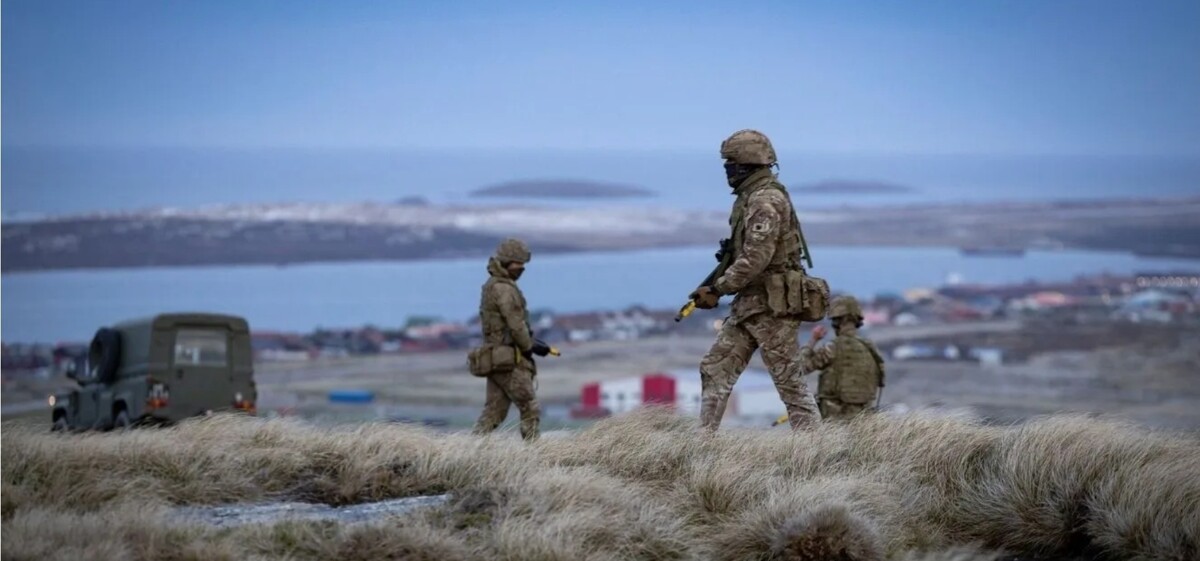
London, February 3, 2026 – The United Kingdom's Armed Forces have weakened to such an extent that they would be unable to guarantee the effective defense of the Falkland Islands in a crisis, according to a former member of the Special Air Service (SAS) and veteran of the 1982 South Atlantic conflict. Mick Hawkes expressed concern over the recent government decision in London to raise the conscription age for military personnel to 65 in the event of war or a national emergency. He stated that this measure does not increase the actual capabilities of the forces in a high-intensity scenario and questioned the operational viability of deploying older personnel for combat roles. "War is a game for the young," he argued, adding that modern combat demands physical conditioning and continuous training that are difficult to maintain at that age. Hawkes went on to compare the present with the past. In 1982, the Royal Navy deployed a powerful task force that included two aircraft carriers, eight destroyers, and 16 frigates, along with a much larger volume of troops and logistical assets. Today, the Royal Navy has two aircraft carriers, six destroyers, and 11 frigatas. The reduction is also significant in terms of personnel. The British Army, for its part, has just over 78,000 soldiers, compared to approximately 163,000 at the time of the conflict with Argentina. "If something like the Falklands happened again, I'm not sure what we could do," Hawkes stated, a remark that caused a strong reaction in British media and defense circles. However, officials from the UK's Ministry of Defence (MOD) argue that the reduction in numbers does not automatically equate to immediate vulnerability in the Falkland Islands. They contend that current deterrence is based not just on the number of ships or soldiers, but on early detection capabilities, rapid response, and technological superiority. Nevertheless, Hawkes's warnings have once again exposed a sensitive debate within the UK: whether the current force model is sufficient to face a high-intensity conventional conflict and sustain distant strategic commitments, such as those for the Falkland Islands, in an increasingly unstable global context.