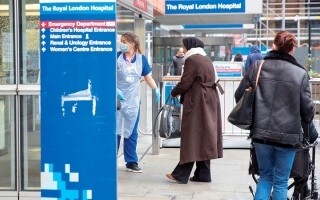
British hospitals need to shrink with fewer beds to help save the country's National Health Service (NHS) from its 'permanent crisis', according to a research center. To enhance the role of hospitals, experts at the 'Nuffield Trust' have called for a 'radical reimagining' to help them tackle widespread overcrowding that has spread over the past decade. The center said that politicians and NHS leaders will have to prepare to pass a controversial program to downsize hospitals to keep the service sustainable. In a new report, the center, formerly known as 'Reform', stated that 'doing so will save the NHS billions, lead to improved patient care, and alleviate pressure on overstretched staff'. Hospital sizes could shrink, leading to the removal of thousands of beds, due to the massive expansion of care provided at or near home. People's need to go to or stay in hospitals will decrease if they can get diagnostics, outpatient appointments, and treatment at home or in community settings, reflecting the changing nature of diseases brought on by an aging population, the center's report says. The report's author, Rosie Bacon, stated: 'It's not about the number of beds, it's about what hospitals do and how they do it. Hospitals can become smaller because you can provide the same level of care, and often better, without people actually having to be there'. She added: 'This will lead to lower running costs in the long term and a financially sustainable system'. Bacon continued: 'Hospitals shouldn't be downsized just for the sake of it, but because the way and place that secondary care is provided no longer needs to be confined to a hospital bed. A natural consequence of a successful health service that reduces the number of people going into hospital through better prevention and faster treatment is that hospitals themselves will appear smaller and different. It's just a reflection of what is required of a modern and preventive NHS'. She pointed out that 'downsizing hospitals is simply a consequence of speeding up care and making it more efficient, and it's not about reducing services, but about delivering them in faster, more convenient, and financially sustainable ways'. Figures from the NHS show that the number of general and acute beds in hospitals in England fell from 180,889 beds between 1987-1988 to 100,916 beds last month. Advances in treatment have shortened patient stays, easing pressure on beds, but hospitals are having to add thousands of beds to help cope with the usual 'winter crisis'. The chief executive of NHS Milton Keynes University Hospital, Dr. Joe Harrison, said: 'The only way to stabilize the service and improve access to and quality of care, and ease the pressure on burnt-out staff, is to radically rethink what hospitals do and how they do it'.