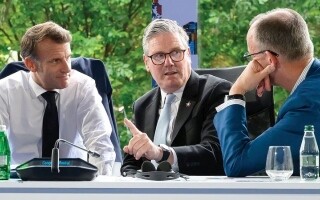
In the current situation, the Labour Party faces difficulties, having come in third place in the Welsh Parliament, failing to unseat the Scottish National Party in the Scottish Parliament, and losing seats to both the Green Party and the Reform Party in the English local elections. Labour MPs are already expecting a real challenge to Keir Starmer as party leader, and his chances of staying on appear slim. Meanwhile, France entered 2026 without a budget for the second year in a row. The good news for President Emmanuel Macron is that the minority government led by Prime Minister Élisabeth Borne will likely reach a budget agreement by late February or March, targeting a modest deficit reduction. With presidential elections just 16 months away and local elections next March, the opposition's appetite for early parliamentary elections has waned. Nevertheless, this is the best-case scenario, as a divided National Assembly (parliament) will maintain a slow-burning crisis until the 2027 elections. Structural problems Finally, while the German economy is expected to see slight growth in 2026, it will not overcome its structural issues. The government of Chancellor Friedrich Merz, largely consumed by ideological divisions, will face difficulties in implementing long-term reforms. With the far-right Alternative for Germany party expected to increase its vote share in the next five state elections, pressure on the government in Berlin will grow. In 2026, a historical truth often forgotten in calm times will be confirmed: freedom, stability, prosperity, and peace in Europe are always fragile. Competitiveness The period of respite provided by American protection for Europe and the exceptional cooperation and integration after World War II has officially ended. From now on, Europe's significance in the new world order will be determined by its response to Russia's increasing hybrid aggression, its diplomatic influence regarding the war in Ukraine, its ability to improve its competitiveness while managing the rise of the far right and addressing existential threats to its economy and security from Russia, China, and the United States. This will determine whether Europe can survive. Germany, France, and Britain face the risk of paralysis at best and destabilization at worst. Europe is besieged by mounting Russian pressure in Ukraine, China undermining its industrial base, and now the U.S. threatening to annex an ally's territory in NATO. The 2026 dilemma: Europe under siege, with escalating external pressure from Russia in Ukraine, China eroding the EU's industrial base, and the U.S. now threatening to annex an ally's territory in NATO, undermining the EU's increasingly outdated multilateral rules in a world more interested in self-interest and less cooperative, with little sign of this changing. In fact, the ongoing erosion of the standards Europe has relied on due to weak bloc leadership, especially in the so-called 'E3' (Germany, France, Britain), will worsen. Looking ahead, Europe's greatest existential risks will come from the transatlantic relationship. For EU leaders, maintaining U.S. cooperation in the war in Ukraine was the primary goal for 2025. The best possible outcome for 2026 is the continuation of the exceptional diplomacy that characterized the past 12 months. However, if new threats emerge in this relationship, particularly concerning Greenland, this balance may prove impossible. Resisting pressure 2026 also began with no signs of Russia offering concessions on its demands for a ceasefire or any willingness to accept the terms of the 20-point plan from the U.S., EU, and Ukraine. This is because Russian President Vladimir Putin believes the military situation in Ukraine will deteriorate, forcing Ukrainian President Volodymyr Zelenskyy to surrender to Russia's demands. Observers believe Putin is mistaken: with Europe's support, Zelenskyy will continue to resist U.S. pressure for territorial concessions and instead increasingly target Russian energy production and exports, as well as resistance along the front line. Of course, this also means that Russian airstrikes on Ukrainian cities and energy infrastructure will also increase. However, Europe's rising military spending, arms purchases from the U.S., funding for Kyiv, and sanctions against Russia, also targeting energy revenue sources, could help maintain the status quo, but this is likely the best-case scenario. Ballot boxes At the same time, European leaders will have to ignore Washington's support for far-right parties, as outlined in the new U.S. National Security Strategy, while secretly doing everything they can to counter any hostile backlash against the established system through the ballot boxes. Specifically, the upcoming elections in Hungary will show whether the 'Make America Great Again' movement can tip the scales in favor of its ideological allies in Europe, where populist and Eurosceptic Prime Minister Viktor Orbán appears poised to lose for the first time in 15 years. Orbán himself is campaigning fiercely to boost voter support, indicating his inner circle already sees defeat as a possibility. His opponent, Péter Magyar, who shares his conservative and nationalist political views but is untainted by any corruption scandals, poses a real challenge, as does the country's stagnant economy and rising prices. While traditional election strategies like financial grants, smear campaigns, and fearmongering about war have proven ineffective for Orbán so far, any military fallout from Ukraine directly affecting Hungary could reignite voter fears and change the course of events. Risk of paralysis Furthermore, these challenges will be exacerbated by the weakness of the 'E3' nations, and Europe's political centrality may continue to erode over a decade. Germany, France, and Britain entered 2026 with weak and unpopular governments, besieged by right-wing and left-wing populism, as well as a U.S. administration that wishes for their collapse. While none of them face general elections, all three countries are at risk of paralysis at best and destabilization at worst. At least one leader, Keir Starmer in the UK, may fall due to an internal rebellion in his party. The key event for the UK this year will be the mid-term elections in May.